| Updated:
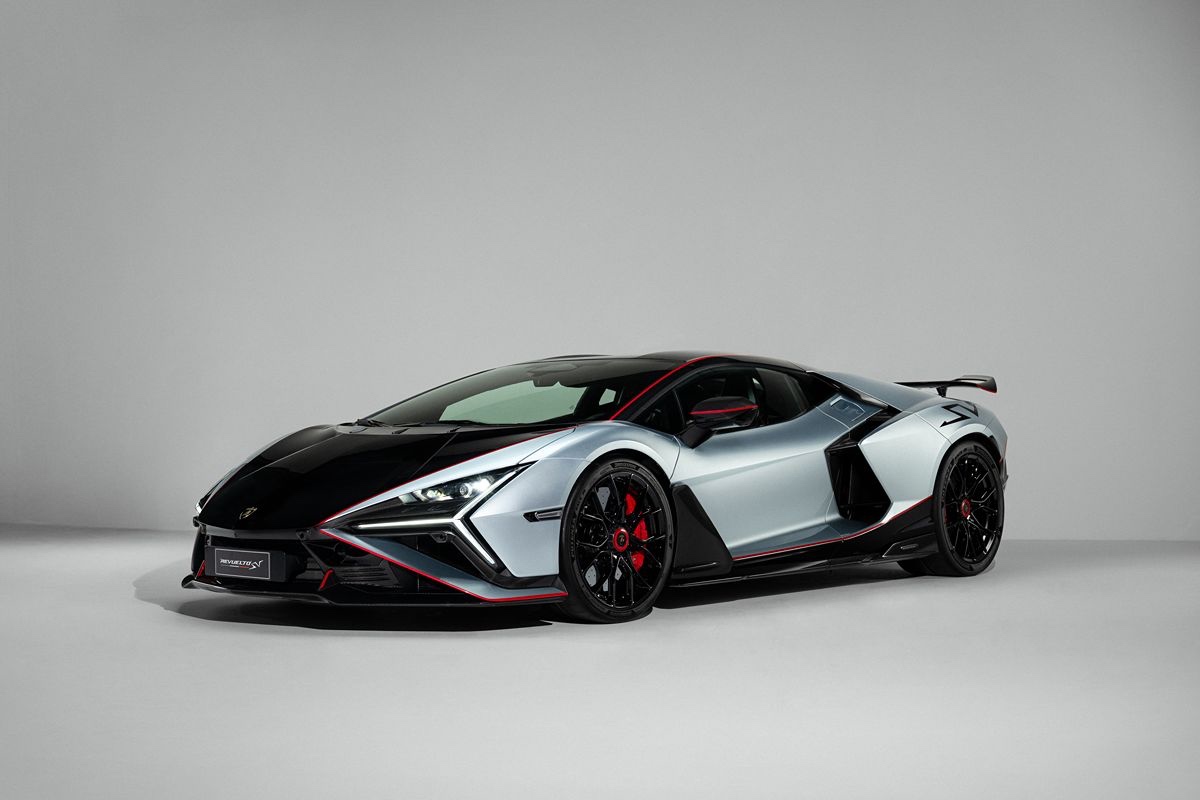
With a name that means ‘super fast’ in Italian, the Revuelto Super Veloce is a supercar that pulls no punches Just unveiled at Monterey Car Week in California, it’s the most powerful production Lamborghini ever – a track-focused flagship reserved for 1,963 of the marque’s ‘most loyal customers’.
How ‘super fast’ are we talking? Well, with a grand total of 1,065hp from its V12 plug-in hybrid drivetrain, the Revuelto SV can blast from 0-62mph in 2.4 seconds, 0-124mph in 6.7 seconds and reach 214mph. In the hands of Lamborghini test driver Marco Mapelli, it has also claimed a road-car lap record at the Hockenheimring in Germany. Will a new Nurburgring record be next?
As for the 1,963 units, that’s a reference to Lamborghini’s birth year, when this former tractor manufacturer launched the elegant 350 GT. The mid-engined Miura arrived three years later and the rest, as they say, is history.
For the new SV, Lamborghini promises more than just ‘super’ statistics. Drivers can also expect more feedback and excitement, including a new ‘Pilota’ mode with highly customisable settings inspired by GT3 racing.
Shortly before the Super Veloce was revealed to the world, we caught up with Alessandro Farmeschi, product line director for the Revuelto, to learn more about this limited-edition Lamborghini. Read on for everything you need to know.
The Super Veloce story so far
The SV badge has long been associated with the most rarefied Lamborghinis. While harder, faster versions of the V8 and V10 models have sported names such as Performante, Superleggera and STO, a Super Veloce has always been powered by a V12.
The Miura SV was the original: the ultimate incarnation of Lamborghini’s – and arguably the world’s – first supercar. Most easily identified by the lack of ‘eyelashes’ around its headlamps, only 150 examples of the 385hp Miura SV were made between 1971 and 1973. Want one today? Expect to spend well into seven figures.
There was no Countach Super Veloce, so the name lay dormant until the Diablo SV of 1996. Again, it had more power – 510hp from a 5.7-litre V12 – but Lamborghini also reduced weight and sharpened the driving experience. Our throwback review of the Diablo SV said it ‘shows the pace of progress since the 1990s, but also how sanitised modern supercars have become’.
A run-out 670hp Murcielago SV followed in 2009, famously starring in a Top Gear film where Richard Hammond tested it on closed desert roads in the Middle East. The 750hp Aventador SV then took a bow in 2015, occupying the top rung of the Lamborghini ladder until the hardcore SVJ (Super Veloce Jota) went one better in 2018.
Mighty V12 and a bigger battery
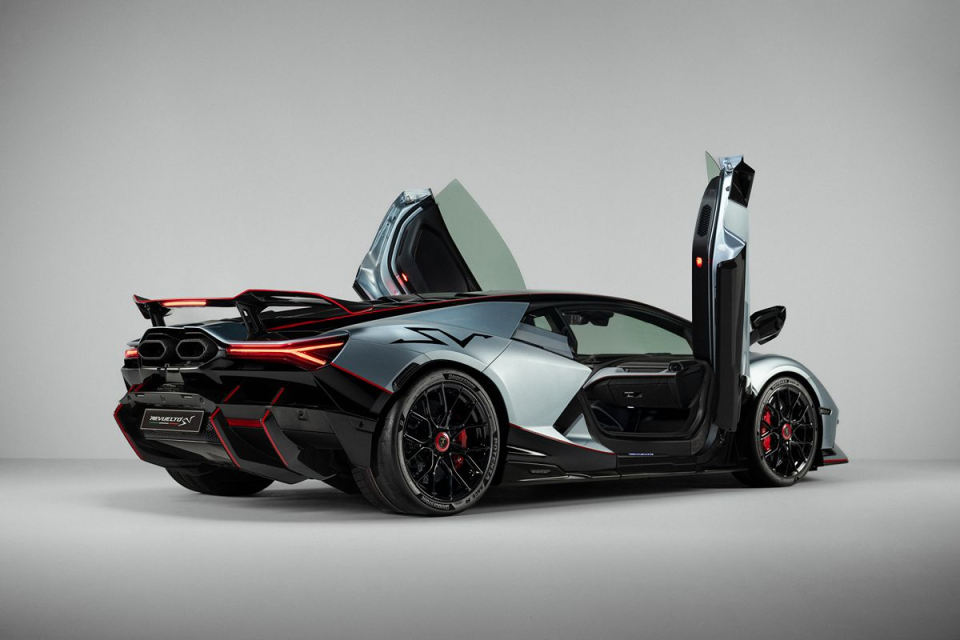
The Revuelto follows the established SV recipe, stirring in extra power, lightweight materials, optimised aerodynamics and a tauter, more precise chassis setup. In each area, however, it’s the finer details that make the difference.
Let’s start with the drivetrain, which combines a 6.5-litre naturally aspirated V12 petrol engine with two axial flux electric motors on the front axle, plus a single radial flux motor located above the eight-speed dual-clutch transmission at the rear.
The 7.3 kWh lithium-ion battery for the hybrid system has almost doubled in size for the SV, but don’t expect any meaningful EV range. What you get instead is torque: a monstrous 1,051lb ft of it, meaning you don’t have to rev the voracious V12 to its 9,500rpm limiter. Spoiler alert: you will anyway.
Power is up by 50hp versus a ‘standard’ Revuelto, while the SV’s dry weight (i.e. measured without fluids) is an identical 1,772kg. Not a light car, then, but given its larger battery and new aerodynamic aids, that seems a commendable achievement.
More downforce, more drama
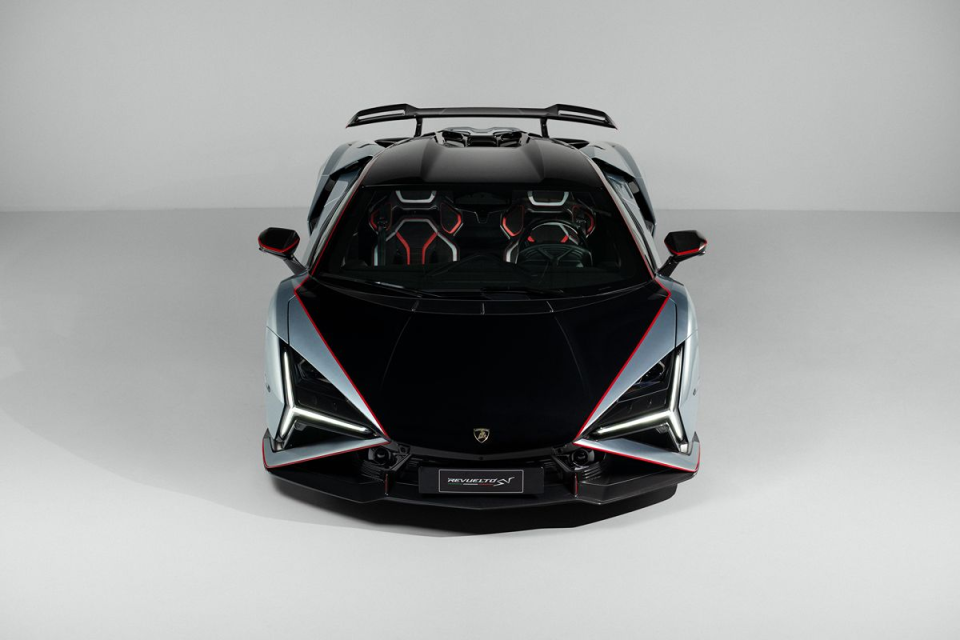
Speaking of aero, the SV’s most obvious visual flourish is a high-mounted rear spoiler, rather than a flush-fitting active item. Developed from racing, it uses a ‘double wing’ design complemented by a gurney flap on the rear deck.
Farmeschi says the biggest gains are found at the front, however, where angled fins and a jutting splitter have doubled downforce. Total downforce is up 80 percent versus a regular Revuelto, and 10 percent compared to an Aventador SVJ.
As is right and proper for a Lamborghini, the SV also looks like it’s doing 214mph when standing still. Low, wedge-shaped and aggressive, it boasts plenty of visible carbon fibre, which design director Mitja Borkert says “emphasizes the car’s wider stance, precision and dramatic presence”. Spot the motorsport-style centre-lock alloy wheels, too.
Customers can specify a range of liveries and custom paint finishes via Lamborghini’s Ad Personam department, including oversized ‘SV’ decals above the rear wheels. First seen on the Diablo, these have become a Super Veloce signature touch.
Designed to deliver on-track
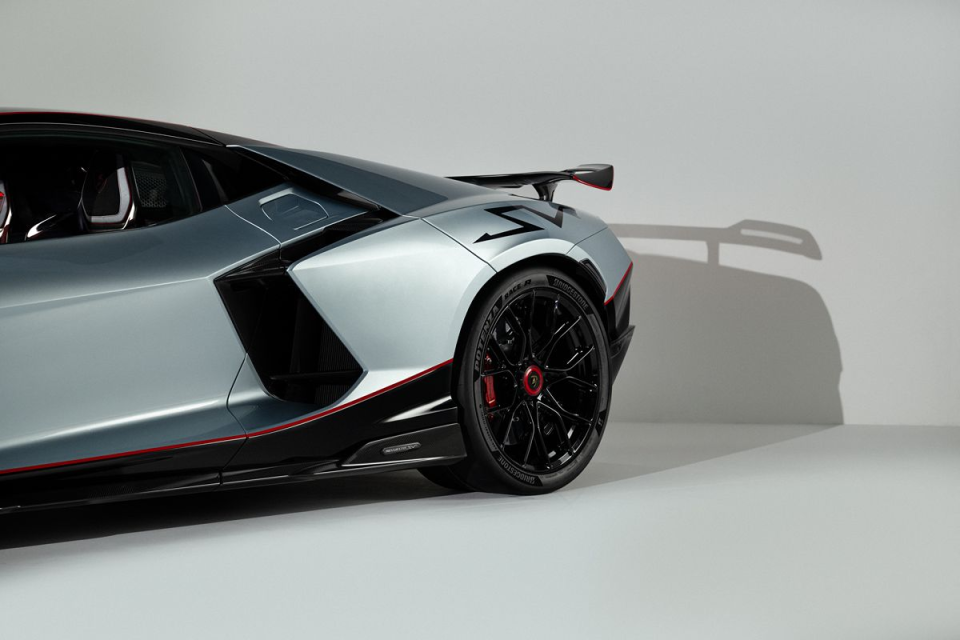
Besides being faster, the Revuelto SV is modified for greater agility and safety at speed. Specially developed Bridgestone Potenza Race R tyres are combined with new manually adjustable dampers that allow the setup to be tailored to a particular circuit. Lamborghini offers suggested settings for flat, bumpy and wet tracks, too.
New ‘CCM-R Plus’ carbon-ceramic brakes, introduced for the SV, dissipate heat more effectively and reduce stopping distances by 11 percent. With huge vented 420mm front discs (410mm at the rear), they can slow the Revuelto from 124mph to a standstill in only 110 metres.
Like Ferrari and Aston Martin, Lamborghini uses a 6D inertial sensor to monitor the car’s movements – including pitch, dive and yaw – and prime its dynamic software. In the SV, this is combined with a new Integrated Brake Control system to prevent wheel lock-up when braking hard or cornering. It also, to quote the official press release, provides ‘increased stability when driving over jumps’. Don’t try this at home, kids.
Lamborghini Revuelto: Engage Pilota mode
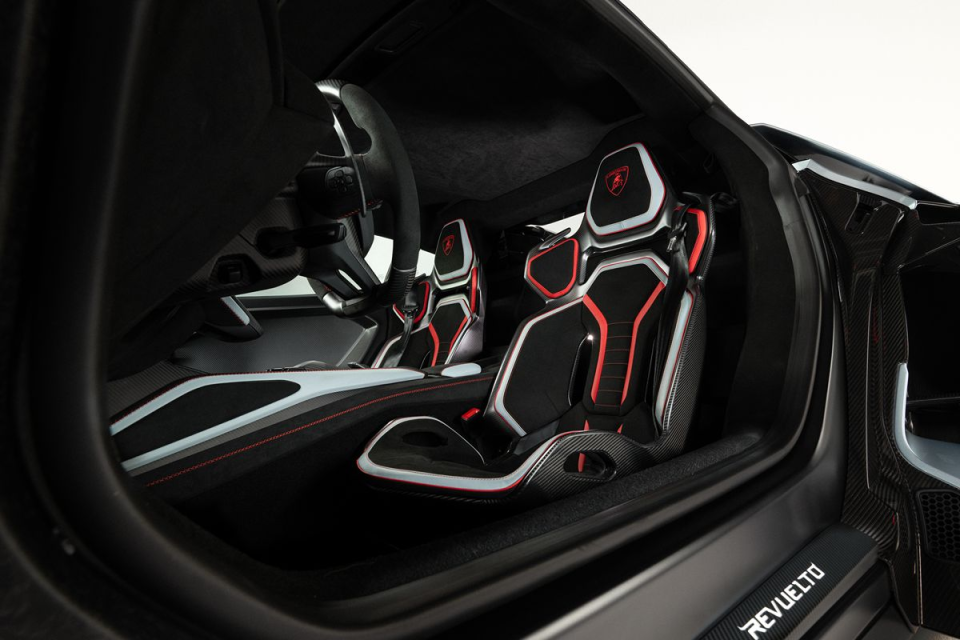
Inside, the Revuelto SV is pared-back and driver-centric, albeit not devoid of luxuries such as air conditioning and infotainment. Again, there is a lot of unadorned carbon fibre on display, including on the door panels and standard Sports Seats. The latter combine a padded carbon shell with an adjustable backrest. Lighter, fixed-back Race Seats are on the options list.
The Revuelto was hardly short of drive modes, from electric-only Citta to attack-the-track Corsa, but the SV gains another one. Pilota mode is accessed by a small button featuring a racing helmet graphic, ringed in red on the steering wheel. This is used to toggle between five levels of traction control, stability control and anti-lock braking depending on the conditions and your driving ability. Similar to the systems used in Lamborghini’s racing cars, Farmeschi describes it as “the icing on the SV cake”.
Despite all the computing technology at work, Lamborghini says the SV will offer a ‘purist driving experience at the highest level’. And with the Revuelto already a critically acclaimed success, we’re prepared to believe it. Fingers-crossed for a first drive later this year…
In the meantime, click here to read our reviews of the Revuelto and the complete Lamborghini range.
• Tim Pitt writes for Motoring Research
PakarPBN
A Private Blog Network (PBN) is a collection of websites that are controlled by a single individual or organization and used primarily to build backlinks to a “money site” in order to influence its ranking in search engines such as Google. The core idea behind a PBN is based on the importance of backlinks in Google’s ranking algorithm. Since Google views backlinks as signals of authority and trust, some website owners attempt to artificially create these signals through a controlled network of sites.
In a typical PBN setup, the owner acquires expired or aged domains that already have existing authority, backlinks, and history. These domains are rebuilt with new content and hosted separately, often using different IP addresses, hosting providers, themes, and ownership details to make them appear unrelated. Within the content published on these sites, links are strategically placed that point to the main website the owner wants to rank higher. By doing this, the owner attempts to pass link equity (also known as “link juice”) from the PBN sites to the target website.
The purpose of a PBN is to give the impression that the target website is naturally earning links from multiple independent sources. If done effectively, this can temporarily improve keyword rankings, increase organic visibility, and drive more traffic from search results.