| Updated:
Beyond the Loire Valley’s fairy-tale châteaux, a gentler side of this celebrated destination awaits. Lucy Daltroff dives in
It takes just over an hour to fly from Stansted to Tours in the Loire Valley and soon I am eating a spectacular lunch and drinking local wine at the rooftop La Belle Vue Restaurant. Before me is the awe-inspiring Tours cathedral, built between 1170 and 1547 with its 13th-century stained-glass windows, and twin towers topped with Renaissance lanterns. It is so beautiful it doesn’t look real.
Most people come to the Loire in search of fairy-tale castles and leave with photographs of turrets reflected in the river, but that familiar image only tells part of the story: spend a few days here and another version of the Loire begins to emerge, one defined by exceptional food, ambitious wines, elegant places to stay and a rhythm of life that feels increasingly rare. It’s this slower Loire that has become the region’s greatest luxury.
I slip into the tempo by taking supper at Nuances, a country riverside restaurant with peaceful surroundings and dishes made using ingredients grown on the family farm. Then it’s on to La Dixmeresse, an elegant B&B in the wine-growing village of Restigné, which produces nearly 40 per cent of the reds of the Bourgueil appellation.
The property is owned by Englishman Charles and his French wife Géraldine, the former a successful international businessman until he changed direction last year.
Loire Valley beyond the cliches
“My kids had left home so we decided to move to France and start a new life here,” he tells me cheerfully. “It is hard work, but I don’t regret a moment of it.”
Looking at Charles’ smile as he serves a homemade breakfast, you can see how much he enjoys his role of “chaleureux hôtelier”.
Just 40km northwest of Tours is a Huttopia Family Camping site, where you can pitch a tent or stay in ready-to-camp accommodation. All comforts are included too, including a heated swimming pool, nature-themed activities and a sauna. I opt for a canoe ride on Lac de Rillé, a serene 200-hectare lake so beautiful I wish I had taken my son to such a gorgeous place when he was a child.
Across Tours and the surrounding villages, a new wave of chefs are creating polished but relaxed restaurants where local produce takes centre stage. Loire fish, goat’s cheese, asparagus, tomatoes, mushrooms and seasonal fruit all appear on menus that celebrate the region without feeling predictable.
Chez Odette is a vineyard restaurant offering French bistro cuisine – The food is wonderful and the presentation even more so. Needless to say, everything is homemade and prices are reasonable in relation to the quality: €10 to €12 for starters, €20 for main courses, €10 for desserts. Three glasses of wine comes in at just €17 (there is an excellent selection).
Wallis Simpson married here
I was shown around the Chateau of Champchevrier by its co-owner Laurence Bizard-Hamilton and her husband Gustaf, a charming double act who take turns filling me in on the property, which has been in Laurance’s family for 11 generations. Living tradition is epitomised in the running of the chateau, with much of it working as it has for centuries. It’s open to visitors from June to September.
Gustaf explains most historic royal castles had to keep a bed prepared for the monarch, who could descend any time. Louis XIII stayed four times, the first in 1619 when he was just 18; after eating a huge supper he asked to sleep on sheaves of straw rather than the lavishly prepared silk bed.
Another visitor some 300 years later was Sir Ronald Hugh Campbell, who was serving as the British ambassador in June 1940, when the British Embassy temporarily relocated to Château de Champchevrier to flee the German advance during the fall of France.
A further British connection lies 30 minutes down the road at the imposing Château de Candé, six miles south of Tours. It was purchased in 1927 by Charles Bedaux, a Franco-American industrial millionaire, and his wife Fern. Charles carried out substantial work to modernise the castle, adding plumbing, central heating and a telephone system, which at the time was unique in a French home.
He also converted the eight bedrooms into en-suites complete with an American system that made it possible to fill and empty the bathtub in less than a minute.
Geometric kitchen gardens
Then, in 1937, his friends the Duke of Windsor (formerly King Edward VIII) and Wallis Simpson needed a private and secure place for their wedding. Bedaux offered them the estate, and they got married here on 3 June, far from the crowds of London, even etching their combined names above each other into the wooden coving.
Although it was a small, private wedding, Cecil Beaton was there to take their wedding photos. Later Bedaux arranged a controversial tour of Nazi Germany for the newlyweds, where they famously met with Adolf Hitler.
Up until now I have merely been visiting these wonderful homes, but now it is time to stay in one. Château de Rochecotte is an outstanding place, a beautiful estate with a spa and swimming pool, although it’s the food that will last longest in my memory.
The restaurant provides comfortably the most elegant meal of my trip, served from sophisticated china plates which complement the splendid dining room. Prices per night at the chateau are about £158 for a standard room.
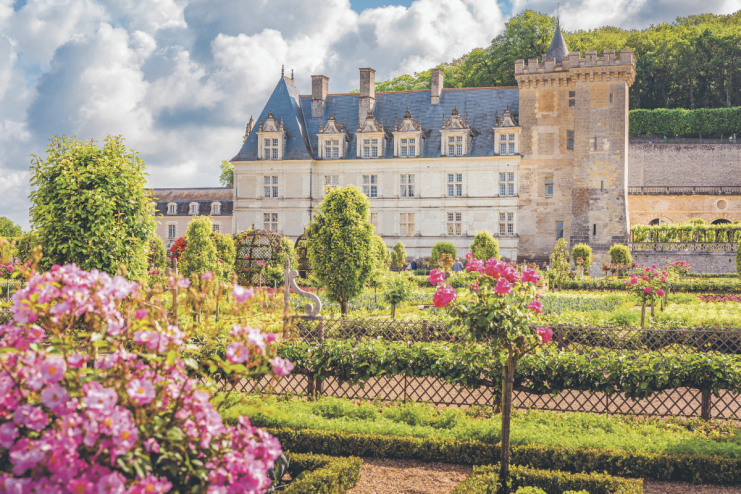
My last chateau tour is to Villandry, a superb house perhaps most famous for its horticulture. Villandry’s geometric kitchen gardens are among the finest in Europe: nine majestic squares unfurl below the chateau in a planted chequerboard. Walking through them you get an overwhelming sense of grandness and serenity, while the surrounding countryside encourages walking and cycling rather than simply driving from one attraction to the next.
Everyone mixes together, it feels refreshing
Nature increasingly shapes the Loire experience – much of the valley is recognised by UNESCO not simply for its architecture but for the cultural landscape created by the vineyards, rivers, forests and villages that have evolved together over centuries.
Just 17 minutes’ drive from Villandry is La Cabane a Matelot or ‘The Sailor’s Cabin’, a small, unpretentious restaurant that offers fish caught by Romain Gadais and cooked by young chef Ambroise Voreux.
Then it is back to Tours itself, a city brimming with history. It was once the capital of the Kingdom of France, and it is now listed as a UNESCO World Heritage Site. I enjoyed walking through Place Plumereau, the jewel in the crown of Old Tours, with its majestic half-timbered houses and unique festive atmosphere. It is also a popular culinary city with specialities including rillettes, cheeses and nougats.
The most unexpected surprise comes in the evening as I walk down some wide stone steps to the banks of the Loire. Here you will find guinguettes everywhere.
Once simple riverside cafés where Parisians escaped during the nineteenth century, today’s guinguettes combine food stalls, local wines, live music and communal tables beneath strings of lights. Families, cyclists, students and visitors mix together, creating an atmosphere that feels refreshingly authentic.
It is here, rather than inside any château, that the Loire’s personality becomes most apparent. It is difficult to leave on my early morning flight, and not just because of the local wine.
Book the Loire Valley yourself
To book La Dixmeresse go to ladixmeresse.fr; To book Huttopia Lac de Rillé go to europe.huttopia.com; For Château de Rochecotte it’s
chateau-de-rochecotte.com; For Chez Odette it’s fredericmabileau.com; For Villandry go to chateauvillandry.fr
PakarPBN
A Private Blog Network (PBN) is a collection of websites that are controlled by a single individual or organization and used primarily to build backlinks to a “money site” in order to influence its ranking in search engines such as Google. The core idea behind a PBN is based on the importance of backlinks in Google’s ranking algorithm. Since Google views backlinks as signals of authority and trust, some website owners attempt to artificially create these signals through a controlled network of sites.
In a typical PBN setup, the owner acquires expired or aged domains that already have existing authority, backlinks, and history. These domains are rebuilt with new content and hosted separately, often using different IP addresses, hosting providers, themes, and ownership details to make them appear unrelated. Within the content published on these sites, links are strategically placed that point to the main website the owner wants to rank higher. By doing this, the owner attempts to pass link equity (also known as “link juice”) from the PBN sites to the target website.
The purpose of a PBN is to give the impression that the target website is naturally earning links from multiple independent sources. If done effectively, this can temporarily improve keyword rankings, increase organic visibility, and drive more traffic from search results.